English
Views: 0 Author: Site Editor Publish Time: 2026-07-29 Origin: Site


End-of-line packaging often dictates the maximum throughput of an entire manufacturing facility. When manual or undersized cartoning processes throttle production, the entire operation suffers from artificial bottlenecks that limit output and strain resources. Mismatching equipment to actual production volume introduces severe operational risks. Over-investing in unnecessary high-speed continuous systems wastes capital and floor space. Under-investing in semi-automatic systems caps revenue potential and inflates labor requirements. Selecting the right equipment requires moving beyond basic speed ratings. Facility managers and packaging engineers must adopt a systematic evaluation framework based on true output requirements, product characteristics, and integration capabilities. By analyzing sustainable throughput rather than theoretical maximums, operations can implement a Cartoning Machine that seamlessly bridges upstream processing and downstream case packing.
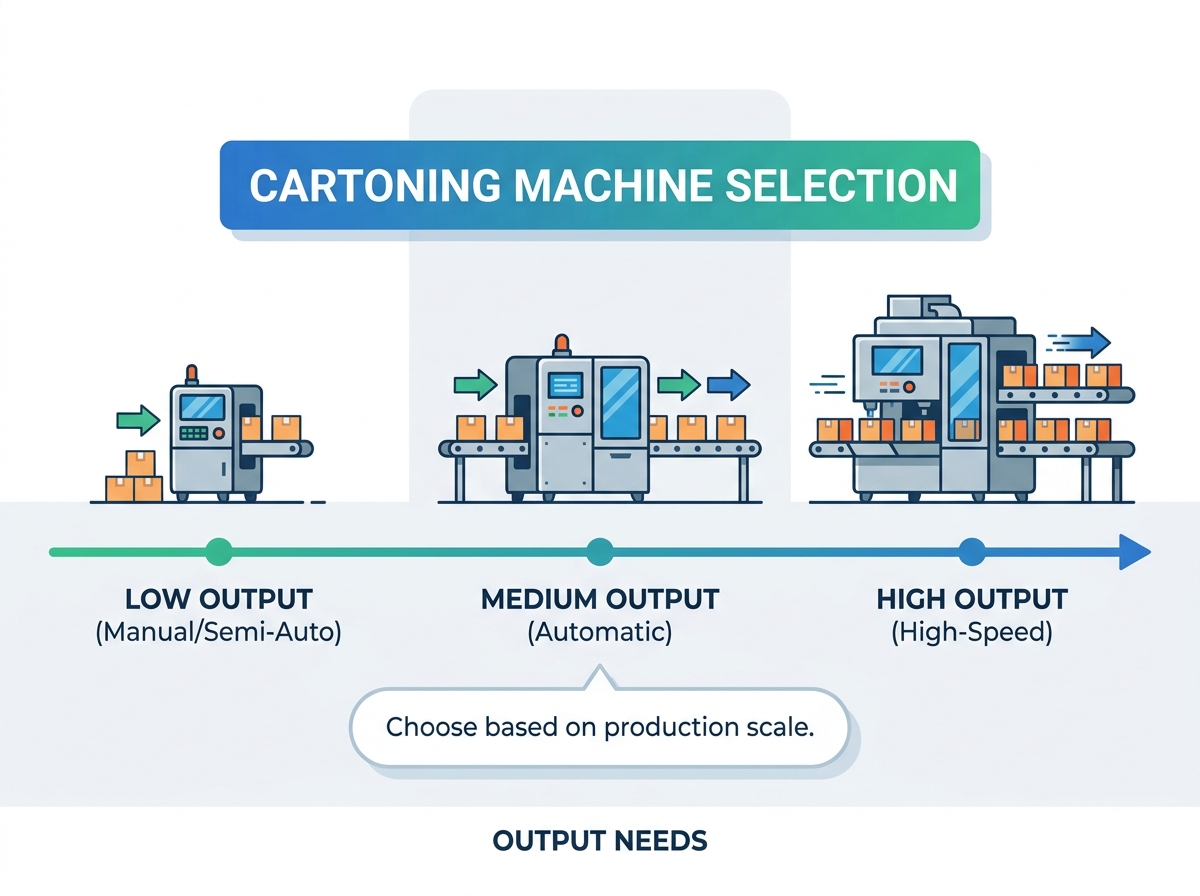
Output dictates motion type: Low-to-medium volumes align with intermittent motion cartoners, while high-speed, high-volume lines require continuous motion systems.
CPM is only a baseline: True output evaluation must account for Overall Equipment Effectiveness (OEE), changeover frequency, and surge capacity, not just maximum Cartons Per Minute (CPM).
Orientation matters: Product characteristics (gravity-fed vs. push-fed) determine whether a vertical or horizontal cartoning machine will achieve the desired throughput without product damage.
Integration is non-negotiable: A high-speed cartoning machine provides zero ROI if upstream processing or downstream case packing cannot match its pace.
Table of Contents
Establishing an accurate production baseline is the most critical step before evaluating equipment specifications. Relying solely on a manufacturer's maximum speed rating inevitably leads to integration failures and missed production targets. You need to look at what the machine will actually do on your floor during a Tuesday afternoon shift, not what it did in a pristine testing lab.
Required CPM must be calculated using actual production targets, shift schedules, and historical downtime data. A machine rated for 200 CPM in a controlled testing environment rarely sustains that speed on a live production floor. To determine your true CPM requirement, follow these specific steps:
Determine your weekly production target based on current demand and immediate forecasts.
Calculate the total available production minutes per week, subtracting all planned downtime, maintenance windows, and shift handovers.
Factor in your historical unplanned downtime percentage to get the true operational minutes.
Divide the weekly production target by the true operational minutes to find your baseline sustainable CPM.
This calculation reveals the sustainable operational speed required to meet demand without pushing the equipment to its mechanical limits. If you need 120 CPM sustained, buying a machine that maxes out at 120 CPM leaves zero room for error. You generally want a buffer of 15 to 20 percent above your sustained requirement.
Packaging lines must accommodate seasonal demand spikes and projected long-term growth. When calculating output needs, establish parameters for a three-to-five-year growth trajectory. A machine running at 90 percent capacity on day one offers no surge capacity. Operations must determine the threshold at which scaling up an existing machine’s speed becomes less efficient than adding a second parallel packaging line. High-speed continuous systems offer massive headroom, but parallel intermittent lines often provide better redundancy and format flexibility. If one machine goes down, a parallel setup ensures you do not lose 100 percent of your packaging capacity.
The actual input speed of any cartoner is entirely dependent on raw product delivery from upstream equipment. Flow wrappers, blister thermoformers, and multi-head weighers dictate the feed rate bottleneck. If a blister line outputs 120 blisters per minute, installing a 300 CPM cartoner provides no additional throughput advantage unless multiple upstream lines feed into a single cartoning hub. Proper synchronization requires mapping the exact output velocity of upstream systems to the infeed capabilities of the cartoner.
Upstream Equipment | Typical Output Rate | Cartoner Synchronization Strategy |
|---|---|---|
Blister Thermoformer | 100 - 300 packs/min | Direct transfer via servo-driven starwheels or smart belts. |
Flow Wrapper | 150 - 400 packs/min | Phasing conveyors to match the pitch of the cartoner infeed. |
Multi-head Weigher | 60 - 120 drops/min | Vertical gravity feed with timing gates to prevent product bridging. |
Availability, performance, and quality metrics must inform baseline requirements before reviewing vendor specifications. A high-speed machine that jams frequently yields a lower OEE than a slower, highly reliable machine. Define acceptable thresholds for micro-stops, reject rates, and format changeovers. These metrics ensure the chosen equipment aligns with the facility's operational reality rather than theoretical performance data. Track how long it takes operators to clear a jam. If a 300 CPM machine takes five minutes to clear, you lose 1,500 cartons of production. A 150 CPM machine that clears in one minute only loses 150 cartons.
Matching machine mechanics to output requirements ensures optimal performance and prevents excessive wear on moving parts. Cartoning systems are broadly categorized by their motion profiles and automation levels. You must align the mechanical design with your specific product mix and volume.
Operating typically between 15 and 60 CPM, semi-automatic systems rely on manual product loading while automating the carton erecting, folding, and sealing processes. These machines are ideal for contract packagers, pilot runs, or facilities managing high product variability. The primary limitation is human ergonomics. Throughput is strictly bottlenecked by the operator's ability to insert products consistently without fatigue. You can add multiple operators to the loading zone, but eventually, physical space limits the maximum speed. They offer excellent flexibility for short runs and strange product shapes that defy automated handling.
Intermittent motion systems generally output 50 to 150 CPM. The defining mechanical characteristic is the indexing system, which stops momentarily at specific stations to allow mechanical pushers to insert the product. Driven by mechanical cams or modern servo-driven indexers, these machines excel at complex, multi-component packaging. Pharmaceutical applications requiring precise insertion of bottles, leaflets, and dosing spoons favor intermittent motion. The momentary pause guarantees precision alignment over raw speed. If a product requires multiple items stacked or nested inside the carton, the stationary loading phase prevents shifting and misalignment.
Designed for dedicated, high-volume lines, continuous motion systems achieve speeds ranging from 150 to over 500 CPM. Cartons and products move continuously in parallel without stopping during the rotary loading phase. Fully servo-driven multi-axis motion controls eliminate the wear-and-tear associated with physical chains and gears. These systems are suited for standardized food packaging, cosmetics, and high-volume pharmaceuticals where product variation is minimal and maximum throughput is mandatory. Because the carton never stops moving, the timing of the barrel cam loaders must be flawless.
Machine Type | Typical CPM | Motion Profile | Best Application |
|---|---|---|---|
Semi-Automatic | 15 - 60 | Operator-paced indexing | High mix, low volume, contract packaging |
Intermittent | 50 - 150 | Stop-and-go indexing | Multi-component kits, pharmaceuticals |
Continuous | 150 - 500+ | Constant parallel motion | Dedicated high-volume lines, food, cosmetics |
The physical characteristics of the product dictate the orientation of the cartoning process. Forcing a product into the wrong orientation causes jams, product damage, and severe throughput degradation. You must evaluate how your product behaves when pushed, dropped, or stacked.
Horizontal machines push products laterally into the open ends of the carton. This orientation is highly efficient for solid, uniform products that can withstand horizontal force. Blister packs, frozen food trays, cosmetic tubes, and stacked flow-wraps are ideal candidates. Horizontal loading allows for higher speeds and easier integration with upstream horizontal conveyors. The product is guided by rails and gently pushed by a mechanical arm into the carton. If the product is flimsy or prone to buckling, horizontal loading will crush it against the carton flaps.
Vertical systems rely on gravity-feeding or top-loading mechanisms. This orientation is mandatory for granular, fragile, or multi-piece products that would spill or jam during horizontal insertion. Powders, loose hardware, glass bottles, and delicate baked goods require vertical cartoning. While generally slower than horizontal continuous systems due to gravity-drop settling times, vertical machines prevent product damage and ensure accurate fill levels. When dropping a heavy glass bottle into a carton, the machine often requires a bottom-cushioning mechanism to prevent the carton from blowing out upon impact.
The closing mechanism and the physical properties of the paperboard directly impact the maximum sustainable speed of the machine. Overlooking material compatibility leads to frequent downtime and high reject rates. You cannot run cheap, warped board on a high-speed machine and expect good results.
Different closure types present distinct operational challenges at varying speeds. Hot melt glue systems allow for high-speed continuous adhesive application but require precise heating and cooling controls. If the temperature fluctuates, the adhesive can string, causing contamination and machine jams at high CPM. You must calibrate the glue gun firing times down to the millisecond.
Tuck-in closures, including airplane, reverse, and straight tucks, rely on purely mechanical folding. While highly reliable and clean, they are speed-capped by the mechanical tolerances of the tucking fingers. If the machine runs too fast, the tucking blade will tear the flap instead of folding it. Combination closures that utilize tamper-evident glue alongside tuck-in flaps add complexity and can extend cycle times if not perfectly synchronized.
Carton board grade significantly impacts structural rigidity during the erection phase. Solid Bleached Sulfate (SBS) offers superior stiffness and clean scoring, making it ideal for high-speed continuous motion. Clay Coated Newsback (CCNB) is more prone to warping and requires robust handling mechanisms. High-speed operations demand positive carton opening features, such as pre-break stations equipped with dual vacuum cups, to force the carton open and prevent erection failures that cause catastrophic jams.
Board Material | Stiffness | Scoring Quality | High-Speed Suitability |
|---|---|---|---|
Solid Bleached Sulfate (SBS) | High | Excellent | Ideal for continuous motion >200 CPM |
Clay Coated Newsback (CCNB) | Medium | Variable | Better for intermittent motion <150 CPM |
Recycled Kraft | Low to Medium | Prone to tearing | Requires positive pre-break opening systems |
A comprehensive equipment evaluation must analyze how the machine interacts with the broader manufacturing environment, operators, and compliance standards. A fast machine sitting idle waiting for parts is useless.
Format changes heavily impact daily output. A machine that runs at 300 CPM but takes three hours to change over will yield less daily output than a 150 CPM machine that changes over in ten minutes. Facilities running multiple SKUs should prioritize tool-less, servo-driven automated changeovers. These systems utilize recipe-driven HMI controls to adjust guide rails and pushers automatically, eliminating the trial-and-error associated with manual mechanical adjustments. Operators simply select the new carton size on the screen, and the machine physically adapts itself.
Machine size must be balanced against output capacity. High-speed continuous systems require significantly more floor space for extended carton magazines and rotary loading mechanisms. Layout considerations must account for operator access, raw material staging, and safe movement around the machine without disrupting the broader facility workflow. You must leave enough clearance for maintenance personnel to access the electrical cabinets and drive motors safely. A machine that fits on a CAD drawing might fail on the floor if you forget to account for material handling equipment. Forklifts and pallet jacks need wide turning radiuses to deliver pallets of flat carton blanks to the magazine loading zone. If the operator has to walk fifty feet to grab a new stack of cartons, the machine will run dry and stop. Design the layout so the carton magazine is easily accessible from the main aisle, and ensure the reject bin can be emptied without crossing active conveyor lines.

A Cartoning Machine must synchronize flawlessly with upstream fillers and downstream case packers. Automated product infeed interfaces, such as bottle starwheels, rotary bucket indexers, and robotic pick-and-place smart belt systems, ensure smooth product handoffs. Furthermore, integration requires accumulation zones. Buffering conveyors prevent minor upstream faults from starving the cartoner and prevent downstream jams from causing immediate upstream shutdowns. If your cartoner outputs 300 CPM but your case packer can only handle 250 CPM, the cartoner will constantly fault out on downstream backup sensors. You must calculate the total line accumulation time. A standard buffering conveyor should hold at least three minutes of production to allow operators to clear minor downstream faults without stopping the cartoner. Smart belt systems use independent servo drives to gap products perfectly before they enter the cartoner infeed, eliminating the need for mechanical timing screws that can scuff or damage delicate packaging.
Engineering compliance dictates construction materials and software architecture. Food and beverage applications require sanitary washdown construction, featuring IP65 or IP69K ratings, stainless steel frames, and sloped surfaces to prevent bacterial harborage. Pharmaceutical applications demand strict validation protocols (IQ/OQ/PQ), 21 CFR Part 11 compliant electronic records, and built-in vision inspection systems to ensure serialization and track-and-trace compliance. You cannot retrofit these compliance features easily; they must be engineered into the frame from day one.
Deploying end-of-line packaging equipment involves inherent risks. Proactive mitigation strategies ensure a smooth transition from installation to full-scale production. You must anticipate failure points before they happen on the floor.
Low-quality paperboard, improper scoring, or warped blanks are the leading causes of machine jams. The risk of downtime increases exponentially with machine speed. Mitigate this by specifying carton tolerances strictly with suppliers. Conduct extensive material testing during the equipment evaluation phase using the exact board grades and coatings intended for production. Do not test with premium board if you plan to run cheap recycled board in actual production.
OEE frequently drops post-installation due to operator unfamiliarity with new HMI controls or troubleshooting protocols. Advanced servo-driven machines require a different skill set than legacy pneumatic systems. Mandate comprehensive, vendor-led training programs and develop standardized operating procedures for clearing jams, performing changeovers, and executing routine maintenance. Operators need hands-on time with the machine before live production begins. Do not rely on a single maintenance technician to understand the machine. Cross-train your primary operators to handle basic troubleshooting, such as clearing sensor faults, cleaning glue nozzles, and resetting servo drives. When operators understand the mechanical sequence of the barrel cam and the rotary feeder, they can identify abnormal noises or vibrations before a catastrophic crash occurs. Document every adjustment made during a shift in a physical or digital logbook to track recurring issues.
Defective cartons that reach downstream case packers cause severe jams and rework. Mitigate this risk by integrating high-speed vision systems directly into the cartoner. These systems scan for incomplete cartoning, missing leaflets, open flaps, or incorrect barcodes. They automatically route defective cartons to a lockable reject bin without stopping the machine. A reliable reject mechanism keeps the line running while isolating quality issues.
Accepting delivery of an untested machine guarantees integration delays. Outline critical steps for conducting a rigorous FAT. Require the vendor to run the equipment at the contracted CPM using actual production materials and live products for a sustained duration.
Run the machine at maximum contracted speed for at least four continuous hours.
Execute a full format changeover from your largest carton to your smallest carton.
Trigger every safety interlock and emergency stop to verify immediate machine shutdown.
Intentionally feed defective products to verify the vision system and reject mechanisms function correctly.
Validate all changeover procedures, safety interlocks, and reject mechanisms before signing off on the delivery.
The best cartoning machine is not necessarily the fastest one, but the one that aligns with your production capacity, product characteristics, packaging materials, and overall packaging line configuration. By focusing on sustainable throughput, automation, integration, and long-term operational efficiency, manufacturers can eliminate bottlenecks, improve Overall Equipment Effectiveness (OEE), and maximize the return on their equipment investment.
To select the most suitable cartoning solution, consider the following recommendations:
Evaluate your actual production requirements using sustainable CPM and OEE rather than relying solely on maximum machine speed.
Match the machine type with your product characteristics, carton style, and future production expansion plans.
Ensure seamless integration between upstream processing equipment, downstream case packers, and factory automation systems.
Perform comprehensive Factory Acceptance Testing (FAT) using your own products and packaging materials before final equipment acceptance.
With extensive experience in pharmaceutical packaging technology and intelligent packaging automation, Chengda has become a trusted global manufacturer of blister packaging machines, cartoning machines, and complete packaging production lines. Supported by continuous research and development, precision manufacturing, and rigorous international quality standards, the company provides reliable packaging solutions for pharmaceutical, healthcare, food, cosmetic, and consumer goods manufacturers worldwide.
From cartoning machines and blister packaging systems to integrated end-of-line packaging solutions, Chengda offers customized equipment design, complete production line integration, professional technical consultation, installation support, operator training, and comprehensive after-sales services. By combining advanced automation technology with customer-focused engineering, Chengda helps manufacturers improve production efficiency, enhance packaging quality, and achieve sustainable growth in an increasingly competitive global market.
A: Continuous motion machines typically operate between 150 and 500 Cartons Per Minute (CPM). The optimal speed depends heavily on product complexity, carton size, and the stability of upstream product feeding. Standard food packaging often runs at the higher end, while heavier or more complex items run closer to 150 CPM. Always match the machine speed to your sustainable upstream feed rate rather than targeting the maximum possible CPM.
A: Intermittent motion machines pause momentarily at specific index stations to allow mechanical pushers to insert the product into the carton. This stop-and-go action is perfect for complex, multi-item insertions. Continuous motion machines load products while both the carton and the product remain in constant, synchronized parallel motion. This continuous movement allows for significantly higher throughput and reduces mechanical wear on the drive components.
A: Yes, most modern machines handle a range of carton sizes. However, this range is strictly limited by the machine's pitch, which is the physical distance between carton pockets on the conveyor. Switching between sizes requires a format changeover. You must adjust guide rails, pushers, and magazine feeds to accommodate the new dimensions. Extreme size differences usually require dedicated machines.
A: Manual changeovers on older or simpler mechanical machines take 30 to 60 minutes and require physical tools to adjust rails and timing cams. Modern, servo-driven machines equipped with automated, tool-less adjustments and recipe-driven HMI controls complete full format changeovers in under 10 minutes. Operators simply select the new carton profile on the screen, and the servo motors adjust the physical guides automatically.
A: The primary culprits for machine jams are poor carton blank quality, incorrect or shallow scoring, warped paperboard, hot-melt glue buildup, and inconsistent upstream product feeding. If the carton does not pop open perfectly at the pre-break station, the product pusher will crush the product against the closed flap. Maintaining strict material tolerances is critical for preventing jams.
A: Recycled board generally has less fiber stiffness than virgin board and is more prone to warping and inconsistent folding. Running recycled board at high speeds requires a machine equipped with a positive carton opening system. Dual vacuum pre-break stations physically pull the carton open from both sides, ensuring reliable erection even when the board lacks natural rigidity.