English
Views: 0 Author: Site Editor Publish Time: 2026-07-29 Origin: Site


High-speed packaging frequently outpaces the capabilities of human inspectors and rigid machine vision systems. Traditional inspection hits an operational ceiling quickly. Minor variations in carton material or lighting trigger false rejects. These false failures compound rapidly, causing undetected micro-defects like skewed flaps, unreadable barcodes, and compromised adhesive seals. Over time, these errors degrade Overall Equipment Effectiveness (OEE) and throttle line throughput. False rejects force manual rework and overwhelm reject bins, while undetected structural defects cause mechanical jams downstream. You need a system that adapts to natural variations without slowing down production. Deep learning, neural networks, and edge computing bridge the gap between high-speed throughput and stringent quality assurance. They provide an adaptive layer, learning to identify complex anomalies in real-time. Understanding How AI-Driven Quality Control Enhances Cartoning Line Efficiency allows plant managers to transform passive inspection stations into proactive optimization points.
OEE Uplift: AI-driven inspection reduces false reject rates (FRR) by adapting to acceptable natural variations in packaging materials, directly increasing machine uptime and line yield.
Adaptive Defect Detection: Unlike traditional vision systems that fail upon minor lighting, substrate, or positioning changes, AI models learn to identify complex anomalies (tears, glue failures, print degradation) in real-time.
Changeover Agility: Machine learning models drastically reduce the time required for SKU changeovers by eliminating the need for manual threshold recalibration and hardware adjustments.
Data-Driven Process Optimization: Advanced integration allows real-time telemetry to feed back into upstream machinery, transforming the inspection station from a passive gatekeeper into a proactive optimization point.
Implementation Reality: Successful deployment requires a structured approach to edge computing infrastructure, robust initial training data, GAMP 5 compliance validation, and seamless PLC integration.
Table of Contents
Traditional pixel-matching and edge-detection algorithms struggle with natural material variations. Recycled carton board features organic shifts in grain, fiber, and color. Ambient lighting changes throughout a production shift as bay doors open and close. Minor positional skewing occurs naturally on high-speed conveyors due to belt wear or slight mechanical vibrations. Rules-based systems rely on rigid thresholds. When a carton deviates slightly from the programmed ideal, the system flags it as a defect.
These strict parameters create technical failure modes. Organic variations in cardboard substrates cause false failures. For example, a dark recycled fiber crossing a barcode quiet zone might trigger a failure in a standard vision system, even though the barcode scans perfectly. The system rejects perfectly acceptable products. This leads to unacceptably high False Reject Rates (FRR). High false-positive rates force manual rework. Operators must inspect rejected cartons by hand, pulling them away from active line management. Reject bins overflow quickly, artificially slowing down the entire packaging line. Machine operators spend more time managing false rejects than optimizing production.
Inspection Parameter | Traditional Rules-Based Vision | AI-Driven Vision Systems |
|---|---|---|
Lighting Tolerance | Fails if ambient light shifts by minor lux values. | Adapts dynamically to shadows and glare. |
Material Variation | Rejects natural fiber or color shifts in recycled board. | Learns acceptable baseline variations. |
Positioning | Requires exact carton presentation within the frame. | Identifies features regardless of minor skew or rotation. |
Setup Time | Requires hours of manual threshold tweaking per SKU. | Utilizes transfer learning for rapid deployment. |
Undetected structural defects cause severe downstream issues. Unsealed flaps, flared edges, and crushed corners pass through rigid vision systems if they fall outside the programmed inspection zone. Out-of-spec dimensions create alignment problems. These physical anomalies lead to machine jams in case packers and palletizers. A single jammed carton causes a micro-stop. Operators must open safety interlocks, clear the jam manually, reset the machine, and restart the sequence.
Micro-stops accumulate over a shift. They destroy line efficiency and reduce overall throughput. A successful inspection system must detect physical and structural anomalies early. It must identify these issues before they cause a mechanical fault downstream. Furthermore, it must perform this detection without introducing processing latency. High-speed lines running at 400 cartons per minute cannot wait for slow image processing. The inspection must happen in milliseconds to trigger the pneumatic reject blow-off accurately.
Legacy smart cameras operate as isolated islands of automation. They capture an image, apply a rigid rule, and trigger a pass or fail signal. They discard the inspection images immediately after processing to save local memory. These systems offer no longitudinal analytical insight. They do not track trends, store data for future analysis, or communicate complex defect data to the central plant network.
This data deficit creates massive blind spots. Maintenance teams remain unaware of progressive component wear. Legacy systems only alert operators when a catastrophic line failure occurs. Without historical image data, engineers cannot perform root cause analysis. They fix the immediate jam but miss the underlying mechanical degradation. Common mechanical failures missed by legacy systems include:
Degrading vacuum cups on the rotary carton erector failing to pull blanks squarely.
Worn conveyor flight lugs causing inconsistent carton spacing.
Partially clogged hot melt glue nozzles applying insufficient adhesive beads.
Drifting printer heads causing smeared or misaligned lot codes.
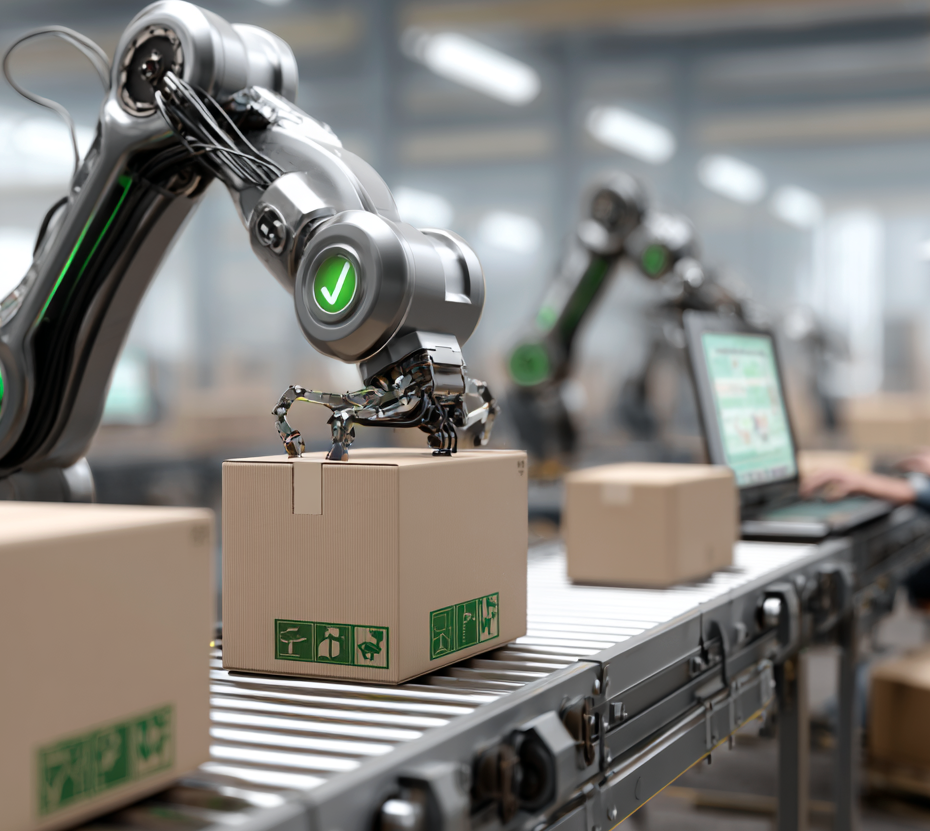
Modern inspection shifts from programmed rules to trained deep convolutional neural networks (CNNs) and vision transformers (ViTs). You train these models on thousands of images. They learn the difference between acceptable variation and actual defects. They do not rely on rigid pixel counting. Instead, they understand the context of the image, much like a human inspector, but at machine speeds.
This technology excels in specific cartoning use cases. Adhesive bead analysis verifies glue line presence and width. Thermal imaging checks glue temperature and position on carton flaps immediately after application. Optical Character Recognition (OCR) verifies variable data. It reads lot codes and expiration dates on highly reflective, skewed, or curved packaging surfaces where traditional OCR fails. The models also assess structural integrity. They verify complex geometric folding and closure completeness at high speeds, ensuring no dog-eared flaps make it to the shrink wrapper.
AI models run continuous inferencing on the edge. They dynamically adapt to acceptable batch-to-batch material variations. Cardboard gloss or color saturation changes between supplier batches. Deep learning models adjust to these shifts without operator intervention. They maintain high accuracy despite natural material inconsistencies, preventing sudden spikes in false rejects when a new pallet of carton blanks is loaded.
These algorithms also isolate and ignore environmental noise. Factory lighting fluctuates throughout the day due to skylights or passing forklifts. Dust from the cardboard blanks accumulates on camera lenses. The cartoner frame vibrates during high-speed operation. Traditional systems fail under these conditions, requiring constant lens cleaning and threshold adjustments. Deep learning models filter out this noise. They focus solely on the critical features of the carton. This adaptability drastically reduces false rejects and keeps the line running smoothly.
Advanced inspection does more than reject bad cartons. It classifies and categorizes defect types in real-time. The system distinguishes between a consistent glue nozzle failure and a carton feed skew. It labels the specific error type and logs the data. This categorization provides immediate insight into machine performance, allowing maintenance to target the exact failing component.
This categorized telemetry pushes via Industrial IoT (IIoT) protocols to upstream mechanical components. The system communicates directly with the PLC. It adjusts glue gun pressure, nozzle timing, or feed gate positioning dynamically. It corrects mechanical errors before they generate scrap. This closed-loop correction transforms inspection from a reactive process into a proactive quality control mechanism.
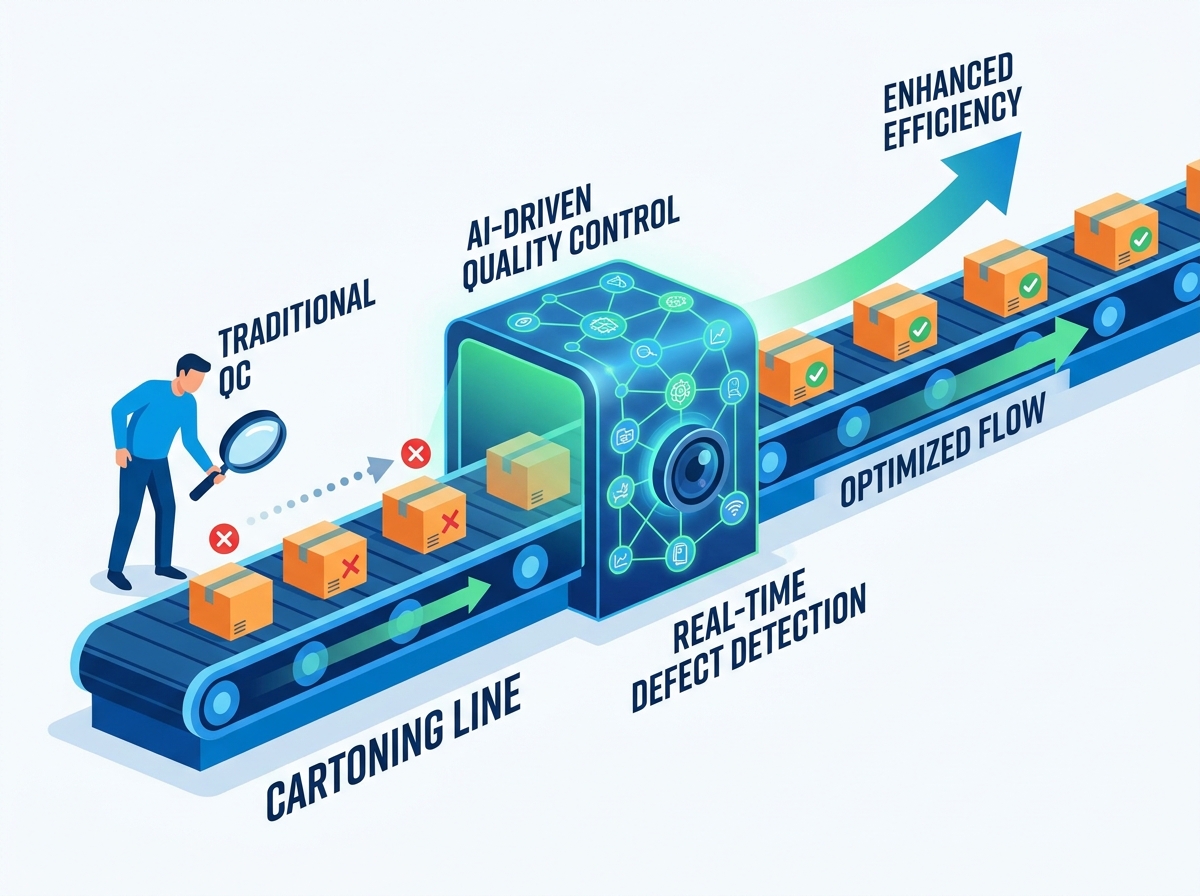
Inspecting 300 to 600 cartons per minute requires immense processing power. At 600 CPM, the machine processes 10 cartons every second. The system must capture the image, run the inference, and trigger the reject mechanism in milliseconds. Localized Edge AI computing uses industrial-grade GPUs or TPUs. This hardware sits directly on the production line, often inside the main control cabinet. It provides sub-millisecond inference times. The complete processing budget remains under 15 milliseconds. This speed ensures pneumatic reject mechanisms fire accurately at high speeds, hitting the defective carton and not the one behind it.
Cloud AI architectures serve a different purpose. You do not use the cloud for real-time reject decisions. Network latency makes cloud inferencing too slow and unreliable for high-speed lines. A minor network hiccup would cause defective cartons to pass. Instead, you reserve Cloud AI for model training and longitudinal data aggregation. The cloud handles fleet-wide system optimization, pushing updated models down to the edge devices. Edge devices handle the real-time execution independently of network connectivity.
Integrating AI vision software with existing industrial control systems requires careful planning. You must connect the vision system to automation layers like Allen-Bradley ControlLogix, Siemens S7, or Beckhoff TwinCAT. The software must communicate seamlessly with the existing PLC logic. It cannot disrupt the established machine timing or encoder tracking.
Real-time industrial communication handshake protocols are mandatory. You must use EtherNet/IP, PROFINET, or EtherCAT. These protocols provide deterministic timing. Deterministic timing ensures physical rejects match digital flags in the shift register. The vision system sends a defect flag, and the PLC tracks that specific carton via encoder pulses until it reaches the reject station. If the timing drifts, the machine rejects the wrong carton. Proper integration guarantees accurate rejection and maintains line integrity.
Steps for integrating AI vision with existing PLCs:
Establish physical network connections using shielded industrial Ethernet cables.
Configure the IP addresses and subnet masks to match the machine network.
Import the Electronic Data Sheet (EDS) or GSDML file into the PLC programming environment.
Map the input/output assemblies to link vision results to the shift register.
Program the reject logic based on encoder pulses to trigger the pneumatic solenoid.
Training an AI model on a new carton size takes hours, not weeks. Manually reprogramming a traditional rules-based vision system requires extensive trial and error. Engineers must adjust lighting, tweak thresholds, and run hundreds of test cartons to ensure stability. Machine learning models streamline this process entirely.
Transfer learning accelerates deployment. The AI applies its baseline knowledge of carton geometry, flaps, and print to new, similar SKUs. You only need to train the model on the specific differences of the new carton, such as a new graphic layout or a different barcode location. A Unified Recipe Management System simplifies changeovers. Changing the SKU on the HMI automatically pushes the corresponding deep learning model to the edge device. Operators complete changeovers in minutes without touching the camera hardware.

AI needs images of defects to learn. High-efficiency operations produce very few defective samples. This industrial paradox creates a "cold start" problem. You cannot train a model to detect a torn flap if you never produce a torn flap. You must employ specific mitigation strategies to build robust training datasets before the system goes live.
Synthetic data generation solves this issue. You utilize Generative Adversarial Networks (GANs) or 3D CAD rendering to simulate photo-realistic packaging defects. You can generate thousands of images of crushed corners or smeared ink without running a single bad carton. One-Class Classification trains models on "good" products only. The system flags anything that deviates from the baseline norm as an anomaly. Supervised pilot phases run the AI in "shadow mode" parallel to existing systems. This captures real-world edge cases without impacting production, allowing the model to learn from actual factory conditions.
Deploying advanced vision requires specific physical requirements. You need high-framerate industrial cameras using GigE Vision or USB3 Vision standards to prevent motion blur on fast-moving conveyors. Specialized lighting configurations are critical. You must use pulsed strobe, co-axial, or infrared lighting to capture clear images at high speeds, overpowering ambient factory light. Ruggedized fanless industrial PCs process the data. These PCs must carry IP65 or IP67 ratings to survive factory conditions, protecting internal components from airborne cardboard dust.
You must mitigate environmental factors. Vibration isolation mounts protect cameras from machine shaking, ensuring sharp image capture. Air knives prevent dust accumulation on optical surfaces, reducing maintenance intervals. Liquid-cooled enclosures protect computing hardware in high-temperature washdown environments. IP69K ratings ensure the equipment survives harsh cleaning protocols, specifically in food and beverage or pharmaceutical packaging halls.
You must address the human element of deployment. Floor operators shift from adjusting software thresholds to labeling edge cases. Intuitive, code-free HMIs make this transition smooth. Operators review flagged images and confirm if they are true defects or acceptable variations. This feedback loop continuously improves the model, turning operators into data curators.
Model drift occurs when accuracy degrades over time. Machine wear, new packaging suppliers, or seasonal lighting shifts cause this drift. You must establish protocols for continuous model validation. Implement MLOps in manufacturing. Create automated alert systems. These systems flag when the confidence level of inferences falls below a defined threshold. This prompts a retraining cycle before quality drops, ensuring the system remains accurate year-round.
Validating non-deterministic machine learning algorithms challenges regulated industries. Pharmaceuticals and Medical Devices require strict compliance. You must outline a compliant approach aligned with GAMP 5 (Good Automated Manufacturing Practice). You cannot deploy a continuously learning model in a validated environment without controls, as the system's behavior would change over time.
Define strict operational envelopes. Lock model weights post-validation to ensure deterministic behavior. The model must perform exactly the same way during every run. Implement automated testing suites for regression testing. Use standard "challenge packs" of known defects. Run these packs through the system to verify model performance during periodic revalidation. This ensures continuous compliance and satisfies regulatory auditors.
Advanced quality control systems support strict compliance mandates. FDA 21 CFR Part 11, EU Annex 11, and DSCSA require robust serialization and traceability. AI vision systems read and verify complex serialization codes at high speeds, even when printed on curved or glossy surfaces. They ensure every carton matches the database record perfectly, preventing misbranded products from entering the supply chain.
These systems create secure, immutable audit trails. They automatically archive images for rejected batches. If a recall occurs, you can retrieve the exact image of the defective carton to prove due diligence. Cryptographic signing of model change histories ensures data integrity. Auditors can verify exactly which model version inspected a specific batch, providing complete transparency into the quality control process.
You must calculate financial ROI based on concrete metrics. First, measure the reduction in scrap material. Minimizing discarded carton blanks and product waste due to false rejects saves significant material costs. Second, calculate reclaimed labor hours. Eliminating manual inspection, sorting, and rework lines frees operators for higher-value tasks, such as preventative maintenance or line optimization.
Next, evaluate OEE improvement. Directly link the reduction in micro-stops and setup times to OEE percentage point gains. Finally, estimate brand protection value. Calculate the cost savings from avoiding market recalls, shipping penalties, and customer-side SLA non-compliance. A robust system pays for itself rapidly through these compounding efficiencies.
ROI Metric | Measurement Method | Operational Impact |
|---|---|---|
Scrap Reduction | Track volume of cartons in reject bins pre- and post-installation. | Lowers direct material costs and waste disposal fees. |
Labor Reallocation | Count hours spent manually sorting false rejects. | Frees operators to manage multiple lines simultaneously. |
OEE Increase | Measure reduction in micro-stops caused by downstream jams. | Increases total shift yield and equipment utilization. |
Changeover Speed | Time required to switch vision recipes between SKUs. | Increases available production time for high-mix facilities. |
AI-driven quality control is redefining the future of high-speed packaging by enabling more accurate inspections, reducing false rejects, improving Overall Equipment Effectiveness (OEE), and supporting intelligent production optimization. By integrating AI vision systems with existing automation platforms, manufacturers can achieve higher packaging quality, lower operating costs, and more reliable production performance across complex packaging environments.
To maximize the benefits of AI-powered inspection, consider the following recommendations:
Evaluate existing inspection performance by analyzing false reject rates, OEE, and recurring quality issues before implementing AI solutions.
Select AI vision systems that support seamless integration with PLCs, MES platforms, and existing packaging equipment.
Establish standardized model validation, operator training, and continuous data optimization procedures to ensure long-term inspection accuracy.
Conduct pilot projects and ROI analysis before full-scale deployment to validate performance improvements and investment returns.
With years of expertise in pharmaceutical packaging equipment and intelligent automation technologies, Chengda has established itself as a trusted global manufacturer of blister packaging machines, cartoning machines, and complete pharmaceutical packaging solutions. Through continuous innovation, advanced manufacturing capabilities, and strict international quality standards, the company delivers highly reliable equipment designed to meet the evolving needs of pharmaceutical, healthcare, food, and consumer goods manufacturers worldwide.
From AI-enabled cartoning solutions and blister packaging systems to fully integrated packaging production lines, Chengda provides customized engineering, intelligent automation solutions, equipment installation, technical training, and comprehensive after-sales support. By combining advanced packaging technology with customer-focused innovation, Chengda helps manufacturers improve production efficiency, enhance quality assurance, and accelerate the transition toward smarter, more sustainable packaging operations.
A: Traditional systems use rigid pixel-matching rules. Minor natural variations in cardboard grain, color, or ambient lighting trigger these rules, causing the system to reject perfectly good cartons.
A: Deep learning models adapt dynamically. They understand the context of the image rather than relying on strict thresholds, allowing them to ignore acceptable batch-to-batch material variations.
A: Yes. Modern systems use industrial communication protocols like EtherNet/IP and PROFINET. This ensures deterministic timing, matching digital defect flags with physical pneumatic reject mechanisms accurately.
A: AI needs images of defects to learn, but efficient lines produce very few defects. You can overcome this by using synthetic data generation or training the model only on "good" products to detect anomalies.
A: You must lock the model weights post-validation to ensure deterministic behavior. You then use automated regression testing with standard challenge packs of known defects during periodic revalidation.
A: No. Network latency makes cloud inferencing too slow for high-speed lines. Edge AI devices handle real-time execution, while the cloud is reserved for model training and data aggregation.