English
Views: 0 Author: Site Editor Publish Time: 2026-07-29 Origin: Site


Inefficient end-of-line packaging creates severe operational bottlenecks on the manufacturing floor. Relying on manual cartoning or deploying mismatched automated systems introduces hidden penalties. These penalties manifest as heavy labor dependency, inconsistent throughput rates, and excessive material waste. Operations managers frequently face the complex challenge of selecting the right equipment to resolve these issues. You must balance required throughput, frequent product changeovers, available floor space, and specific physical product characteristics. This guide serves as a technical framework for operations managers and packaging engineers. It will help you evaluate equipment, match machine types to specific production applications, and mitigate implementation risks. Choosing the correct Cartoning Machine ensures seamless production flow and protects your overall line efficiency.
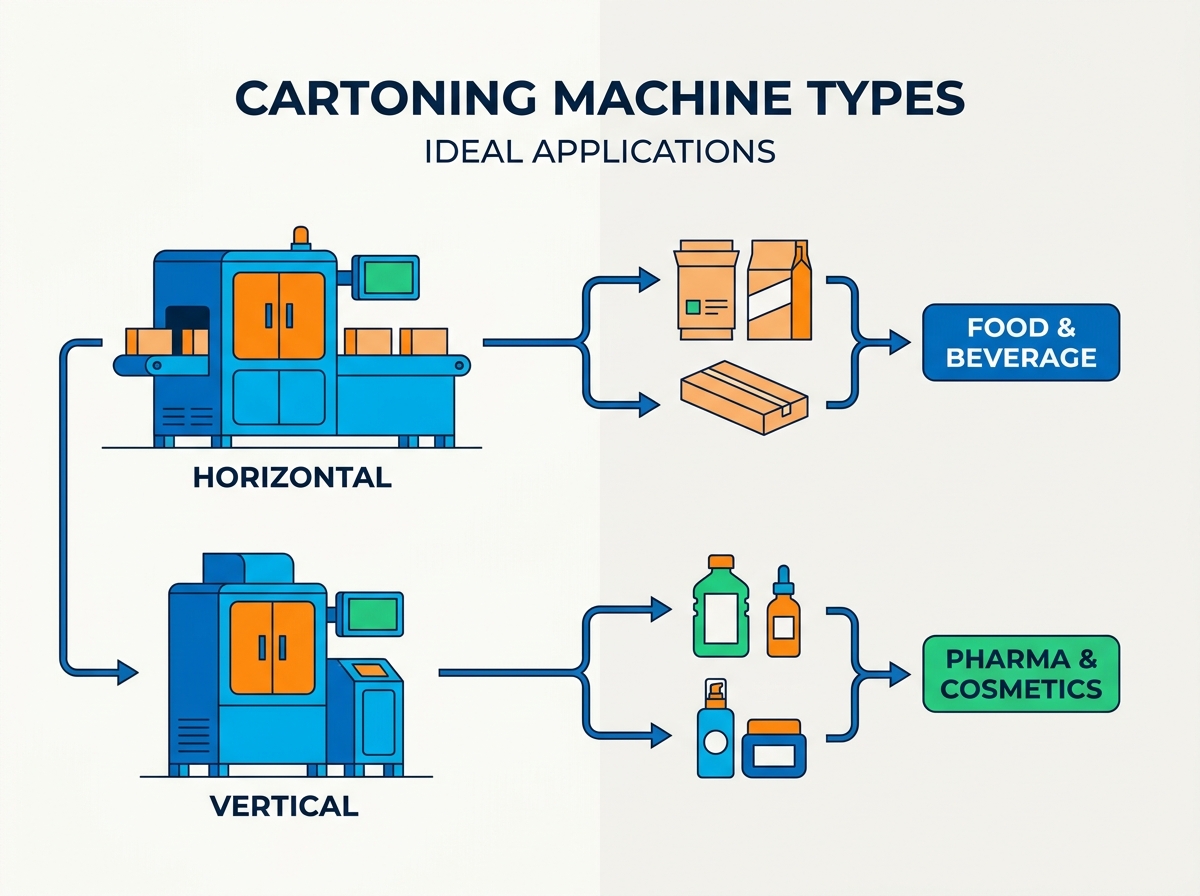
Application Dictates Orientation: Horizontal cartoners are optimal for rigid, stable products (trays, blisters), while vertical cartoners excel with gravity-fed, loose, or fragile items (bottles, vials, granular products).
Motion Defines Throughput: Intermittent motion machines provide the dwell time necessary for complex, multi-component loading, whereas continuous motion machines are strictly for high-speed, high-volume, standardized runs.
Feeder Style Impacts Reliability: Rotary vacuum carton feeders are essential for high-speed continuous operations to prevent carton misfeeds, whereas reciprocating feeders suit slower, intermittent lines.
Changeover is a Hidden Cost: For high-mix, low-volume facilities, tool-less changeover capabilities and servo-driven adjustments often yield a higher ROI than raw maximum machine speed.
Integration is Critical: A cartoning machine cannot be evaluated in a vacuum; its success depends entirely on seamless synchronization with upstream infeed systems, downstream case packers, and mandatory serialization hardware.
Table of Contents
You must first define your baseline production metrics. Compare your current units per minute against your projected future capacity requirements. Sizing a machine based solely on average output often leads to bottlenecks during peak production. Analyze the impact of surge rates and accumulation buffers on your line. Your surge-to-steady-state ratio dictates the necessary mechanical headroom.
Always compare nominal machine speeds against actual throughput adjusted for Overall Equipment Effectiveness (OEE). A machine rated for 300 cartons per minute may only deliver 240 effective units when factoring in micro-stops, upstream delays, and material replenishment cycles. You need to calculate the exact accumulation space required between the primary packaging equipment and the cartoner to absorb these micro-stops without shutting down the entire line.
Throughput Metric | Definition | Impact on Machine Selection |
|---|---|---|
Nominal Speed | The theoretical maximum mechanical speed of the machine running empty. | Used only as a baseline for mechanical capability, never for production planning. |
Surge Speed | The speed required to clear accumulated product after a downstream micro-stop. | Dictates the required motor sizing and servo capacity to handle temporary over-speed conditions. |
OEE-Adjusted Speed | Actual output accounting for availability, performance, and quality losses. | The true metric for calculating return on investment and line balancing. |
The structural integrity of your carton blanks directly impacts machine performance. Evaluate materials like chipboard, solid bleached sulfate, corrugated board, and recycled materials. Recycled materials often behave differently under vacuum erection due to varying porosity, stiffness, and memory. If the board has too much memory, it will resist opening and cause misfeeds in the magazine.
Feeder mechanism selection determines reliable operation. Rotary vacuum feeders provide high reliability for high-speed carton erection. They pull blanks smoothly without abrupt stops, utilizing planetary gears to match the speed of the carton transport chains. Reciprocating or pull-down feeders offer a highly effective solution for low-to-medium speed runs, utilizing a linear motion to pull the blank and force it open against a stationary guide.
Closure requirements dictate the mechanical execution at the discharge end. Consider the following closure styles and their mechanical demands:
Straight Tuck: Requires simple folding plows and a final tucking mechanism. Prone to opening if the product shifts during transit.
Reverse Tuck: The most common pharmaceutical closure. Requires upper and lower tucking mechanisms operating on opposite sides of the carton.
Hot-Melt Adhesive: Demands precise glue nozzle patterns, heated hoses, and compression sections to hold the flaps closed until the adhesive sets. Requires regular maintenance of the glue pots to prevent charring.
Tamper-Evident Sealing: Utilizes tuck-in flaps reinforced with hot-melt glue or external adhesive labels applied immediately after discharge.
Map your available floor footprint accurately. You must include required clearances for operator access, maintenance doors, and bulk material loading zones. A machine that fits perfectly on a layout drawing may fail if operators cannot access the carton magazine safely while the machine is running.
Document all utility requirements thoroughly. Verify your pneumatic air supply can deliver the required cubic feet per minute at a consistent pressure. Drops in air pressure will cause vacuum cups to drop cartons, leading to immediate jams. Confirm electrical loads, including voltage, phase, and required amperage. Note any specific environmental controls, such as washdown exposure ratings or cleanroom compliance standards.
Horizontal equipment erects the carton horizontally and aligns it with a moving product pocket. The system then pushes the product laterally into the open end of the carton. This lateral loading utilizes barrel cams, mechanical pushers, or robotic loaders. The product must slide smoothly across the dead plate and into the carton without catching on the minor flaps.
These systems are ideal for blister packs, flow-wrapped bars, frozen pizzas, pharmaceutical trays, and tubes. The lateral pushing motion requires a product with inherent structural stability. Horizontal systems fail when handling items that lack stability during horizontal transfer, such as loose powders, small hardware, or highly flexible pouches that buckle under the pressure of the pusher rod.
Vertical equipment erects the carton vertically, leaving the top flaps open. Products are then dropped or placed into the carton from above. Loading mechanisms include gravity feeding through volumetric cups, manual operator loading, or multi-axis pick-and-place robotics equipped with specialized end-of-arm tooling.
Vertical loading excels with loose items like hardware or candies. It handles fragile goods, cosmetics, bottles, vials, powders, and complex multi-component kits effectively. However, vertical systems generally operate at slower speeds compared to horizontal counterparts. They typically run under 120 units per minute. They also require specific overhead clearance to accommodate feeding scales, augers, and dosing mechanisms.
The choice between intermittent and continuous motion dictates the entire architecture of your packaging line. Intermittent motion systems feature conveyor chains and carton transports that stop briefly during the product insertion phase. This dwell time allows for complex loading sequences.
Feature | Intermittent Motion | Continuous Motion |
|---|---|---|
Product Loading | Machine pauses; product is pushed or dropped in while stationary. | Product and carton move parallel; barrel cam slides product in dynamically. |
Speed Range | 30 to 120 cartons per minute. | 150 to 400+ cartons per minute. |
Ideal Applications | Multi-component kits, leaflet insertion, delicate handling. | High-speed single items, standard pharmaceutical blisters. |
Mechanical Wear | Higher wear on chains and drives due to constant starting and stopping. | Lower wear per cycle due to smooth, continuous operation. |
Semi-automatic systems require operators to manually place the product into a machine-erected carton. The machine then automatically folds and seals the flaps. This setup suits low-volume production and highly variable products. It works well for short production runs where automated product handling is physically unfeasible or requires excessive custom tooling.
Fully automatic systems handle the entire process without human intervention. They extract the blank from the magazine, erect it, load the product, and seal the discharge flaps. These systems require rigid upstream product control. You must implement automated infeed collation and strict product orientation standardization for successful operation. If the upstream product arrives skewed, the automatic loader will crush the product against the carton face.
Evaluate the downtime transition window required between different carton dimensions. Compare standard changeover procedures against quick-change capabilities. Servo-driven, recipe-based changeovers via a Human-Machine Interface (HMI) offer immense value. They automatically adjust guide rails, pushers, and bucket spacing at the push of a button. This contrasts sharply with manual hand-crank adjustments relying on digital counters, which require operators to walk around the machine adjusting dozens of individual points.
Digital position verification reduces operator error significantly. Implement tool-less quick-change parts, such as snap-in buckets and adjustable carton pockets. These features drastically reduce the time required to switch production runs. When evaluating a machine, ask the vendor to demonstrate a complete changeover from the smallest to the largest carton size, and time the process strictly.
Assess the compatibility of infeed systems and collation mechanisms. Your equipment must integrate smoothly with smart belts, star wheels, scroll feeders, robotic pick-and-place units, and bucket conveyors. The handoff point between the primary packaging machine and the cartoner infeed is the most common source of jams. Downstream handoff is equally critical. Ensure a smooth transition to checkweighers, bundlers, stretch wrappers, labelers, and case packers.
Evaluate line control and synchronization capabilities. The machine must throttle its speed based on upstream bottlenecks or downstream backups. Cascade control logic allows automatic speed modulation. This prevents hard line stops and reduces wear on mechanical components. If the case packer stops, the cartoner should automatically ramp down to a standby speed, allowing the accumulation conveyor to fill, rather than executing an emergency stop.
Examine the Programmable Logic Controller (PLC) architecture. Ensure compatibility with your existing plant networks. Standardizing on a single PLC platform across your facility reduces spare parts inventory and simplifies troubleshooting for your maintenance team. Intuitive HMIs are vital for operational success. They provide real-time diagnostics, visual troubleshooting guides, and digital schematics directly to the operator.
Evaluate the data extraction capabilities of the control system. Utilize protocols like OPC-UA or Ethernet/IP for seamless data transfer to your Manufacturing Execution System (MES). Track OEE, specific downtime codes, and reject rates to drive continuous improvement initiatives. The machine should automatically log every fault, detailing the exact sensor that triggered the stop and the duration of the downtime.
Integrate vision systems to verify critical quality parameters. Cameras must confirm carton opening success, flap closure integrity, barcode correctness, and lot code legibility. If a flap is skewed or a barcode is unreadable, the system must flag the carton immediately.
Serialization and aggregation are mandatory in many regulated industries. The equipment must integrate thermal inkjet printers, laser coders, and camera verification systems. Barcode scanning for product-to-carton matching prevents mismatched inserts, which is critical in pharmaceuticals and infant nutrition.
Implement isolated, lockable reject bins. Utilize shift-register tracking within the PLC. This ensures defective or unverified cartons are tracked through the machine and removed accurately at the discharge station without stopping the production line. The system must verify that the rejected carton actually entered the reject bin using a cross-beam sensor; otherwise, the machine must halt.

Every mechanical system experiences wear, but identifying and managing high-wear components prevents catastrophic failures. Suction cups and vacuum generators require frequent inspection. As suction cups age, the rubber degrades, losing the ability to grip carton blanks securely. Timing belts stretch over time and require tensioning to maintain precise synchronization between the product infeed and the carton transport.
Hot melt nozzles clog if the adhesive is left at operating temperature during extended machine pauses. Carton transport chains elongate after millions of cycles, requiring adjustment to keep the carton pockets perfectly square. Document these components and establish a strict preventative maintenance schedule based on machine cycles, not just calendar days.
Evaluate the vendor's domestic spare parts inventory. A machine is useless if a proprietary servo motor takes six weeks to ship from overseas. Establish a Service Level Agreement (SLA) for technical support response times.
Implement remote diagnostic capabilities using secure VPN routers. This allows the manufacturer's engineers to log into the PLC remotely, troubleshoot logic faults, and force sensor inputs without traveling to your facility. This capability turns a potential three-day downtime event into a thirty-minute software fix.
Define a rigorous Factory Acceptance Testing checklist before shipping the equipment. Run the machine with actual production materials and live product. Do not use blank, unprinted cartons for the FAT, as the ink and varnish on final production cartons change the friction coefficient and porosity. Use challenging carton tolerances to simulate real-world variability.
Operate the equipment at maximum speed for a sustained duration, such as a four-hour continuous run. Test all fault conditions deliberately. Trigger missing product sensors, jam cartons, open guard doors, and lower glue temperatures. Verify that safety circuits, recovery procedures, and diagnostic messages function accurately. The machine must clear faults gracefully without requiring a complete mechanical reset.
Complex machinery can easily overwhelm line operators and maintenance technicians. This knowledge gap leads to extended downtime and poor machine performance. Operators will often bypass sensors or force mechanical adjustments if they do not understand the root cause of a fault.
Mitigate this risk by mandating comprehensive vendor training during Site Acceptance Testing (SAT). Require video documentation of all standard operating procedures. Record detailed changeover procedures, routine maintenance tasks, and common troubleshooting steps. Build a digital library of these videos accessible directly from the HMI or a tablet on the production floor.
Evaluate hygienic design features for food and pharmaceutical applications. Look for appropriate washdown ratings, such as IP65 or IP69K. Ensure stainless steel construction and sloped surfaces that prevent debris accumulation. Verify sanitary cable routing to eliminate bacterial harborage points. Avoid machines with exposed threads or flat horizontal surfaces where dust and product spills can accumulate.
Detail the execution of rigorous validation protocols. Plan for Installation Qualification (IQ), Operational Qualification (OQ), and Performance Qualification (PQ). Ensure the control system complies with Good Manufacturing Practices (GMP) and FDA 21 CFR Part 11 requirements for electronic records and signatures. Every parameter change must require a unique user login and generate an unalterable audit trail.
Selecting the right cartoning machine requires a comprehensive evaluation of product characteristics, production capacity, packaging materials, automation requirements, and line integration. By choosing equipment that aligns with both current manufacturing needs and future expansion plans, manufacturers can improve production efficiency, reduce operational costs, and achieve more stable, reliable packaging performance.
To maximize your equipment investment, consider the following recommendations:
Define detailed production requirements, packaging specifications, and throughput targets before selecting a cartoning machine.
Evaluate compatibility with upstream processing equipment, downstream packaging systems, and factory automation platforms.
Prioritize flexible machine designs with fast changeover capabilities to support future product diversification.
Conduct comprehensive Factory Acceptance Testing (FAT) and production validation using actual products and packaging materials before final acceptance.
With extensive experience in pharmaceutical packaging equipment and intelligent automation solutions, Chengda has become a trusted global manufacturer of blister packaging machines, cartoning machines, and complete packaging production lines. Driven by continuous innovation, advanced manufacturing technologies, precision engineering, and rigorous international quality management systems, Chengda provides reliable, high-performance packaging equipment that serves pharmaceutical, healthcare, food, cosmetics, and consumer goods manufacturers around the world.
From cartoning machines and blister packaging systems to fully integrated packaging automation solutions, Chengda offers customized production line design, intelligent equipment integration, technical consulting, installation support, operator training, and comprehensive after-sales services. By combining engineering expertise with customer-oriented innovation, Chengda helps manufacturers optimize production efficiency, improve packaging quality, and build smarter, more competitive manufacturing operations for long-term success.
A: Horizontal machines erect cartons laterally and push stable products into the open ends. They are ideal for high-speed runs of rigid items like blisters. Vertical machines erect cartons upright, allowing loose or fragile products to be dropped or placed from above.
A: Rotary vacuum feeders use a continuous spinning motion to pull blanks smoothly, making them highly reliable for high-speed continuous operations. Reciprocating feeders use a back-and-forth pulling motion, which is cost-effective and suitable for slower, intermittent lines.
A: Continuous motion machines keep both the product and carton moving parallel to each other without stopping. Depending on the product and carton size, they typically operate at high speeds ranging from 150 to over 400 cartons per minute.
A: Yes. Modern machines feature adjustable guide rails, pockets, and servo-driven changeover capabilities to handle various sizes. However, switching between entirely different closure styles, like tuck-in to hot-melt glue, often requires specific modular tooling or dedicated machine sections.
A: This sensor logic detects if a product is missing from the infeed conveyor. If no product is present, the machine skips erecting a carton for that specific cycle. This prevents the system from sealing empty boxes, saving expensive packaging materials.
A: Pharmaceutical installations require strict validation, including Installation Qualification (IQ) to verify proper setup, Operational Qualification (OQ) to test functional limits, and Performance Qualification (PQ) to ensure consistent production. The software must also comply with FDA 21 CFR Part 11.
A: They integrate using synchronized infeed systems like smart belts, scroll feeders, or robotic pick-and-place units. Advanced control systems use cascade logic to automatically throttle the cartoner's speed based on the flow rate of the upstream equipment, preventing jams and line stops.