English
Views: 0 Author: Site Editor Publish Time: 2026-09-21 Origin: Site


Primary packaging dictates pharmaceutical manufacturing success. Compromised barrier integrity ruins drug efficacy, threatens patient safety, and triggers regulatory audits. Plant managers face a constant battle on the production floor. You must push production throughput to the limit and handle diverse formats like tablets, capsules, softgels, and sublinguals. Simultaneously, you have to maintain strict cGMP compliance without blowing up operational expenses. Balancing these demands requires heavy-duty engineering and precise equipment selection.
You need a structured evaluation framework for selecting a Blister Machine. This framework must prioritize technology types, integration capabilities, and material adaptability. Evaluating equipment based on raw technical merit prevents bottlenecks. It guarantees your packaging lines can handle future product pipelines and strict sustainability mandates.
Technology Alignment: The choice between thermoforming (plastic-based) and cold forming (Alu-Alu) must be dictated by the specific moisture, oxygen, and light sensitivity of the pharmaceutical product.
Operational Agility: Modern blister machines prioritize rapid, tool-less format changeovers to support high-mix, low-volume production runs and minimize machine downtime.
Compliance and Validation: Equipment must natively support 21 CFR Part 11 compliance for data integrity and offer streamlined IQ/OQ/PQ validation pathways.
System Integration & Industry 4.0: Standalone blister machines are increasingly obsolete; seamless integration with downstream cartoners, serialization modules, and IoT-enabled predictive maintenance systems is a mandatory evaluation criterion.
Sustainability Readiness: Forward-looking investments require machines capable of processing emerging eco-friendly, recyclable mono-materials without compromising speed or seal integrity.
Table of Contents
You must define the required output capacity in blisters per minute (BPM). This metric must align with your current batch sizes and projected facility growth. High-speed continuous motion machines excel in producing blockbuster drugs. They utilize rotary sealing cylinders to achieve massive throughput, often exceeding 800 BPM. These machines handle long, uninterrupted production runs. They keep web tension consistent and maximize output for dedicated product lines.
Intermittent motion machines offer a different mechanical advantage. They use flat platen sealing mechanisms. The web stops momentarily while the heated plates press together. This design better accommodates complex feeds and specialized formats. Intermittent machines operate at lower speeds, typically between 100 and 300 BPM, but provide superior control. They handle fragile products and complex laminate structures effectively. High-mix facilities benefit heavily from intermittent motion architectures due to their inherent flexibility.
When evaluating throughput, you must look beyond the theoretical maximum speed. Overall Equipment Effectiveness (OEE) matters more than raw BPM. A machine rated for 600 BPM that suffers from frequent micro-stops or feeding jams will yield less daily product than a stable 400 BPM machine. You must evaluate the equipment's ability to maintain steady-state production without operator intervention.
The physical properties of your product dictate the required feeding system. Standard tablets exhibit specific friability levels. Softgels present stickiness challenges, especially in humid environments. Capsules vary significantly in size, weight, and center of gravity. Selecting the wrong feeder guarantees high scrap rates and constant machine faults.
Consider these specific feeding mechanisms based on product type:
Universal Brush Box Feeders: These handle many standard, hard-coated tablets. Rotating brushes sweep the product into the formed cavities. They offer high speed but can damage highly friable products.
Dedicated Tube Feeders: These provide precise, individual placement for capsules and oblong tablets. They prevent product bouncing and ensure correct orientation before sealing.
Vibratory Tracks: These work well for robust tablets. They use high-frequency vibration to align and feed products down a chute.
Pick-and-Place Robots: These handle extremely fragile or oddly shaped products. Vacuum nozzles lift and place the product directly into the cavity with zero drop height.
Handling fragile formats requires specialized engineering. Sublingual tablets and orally disintegrating tablets (ODTs) demand gentle handling. You must ensure precise dosing and placement without chipping the edges. Dust generation during feeding compromises seal integrity. If tablet dust settles on the sealing web, the lidding foil will not adhere properly. Advanced feeding systems use vacuum dust extraction and minimal drop heights to prevent this contamination.
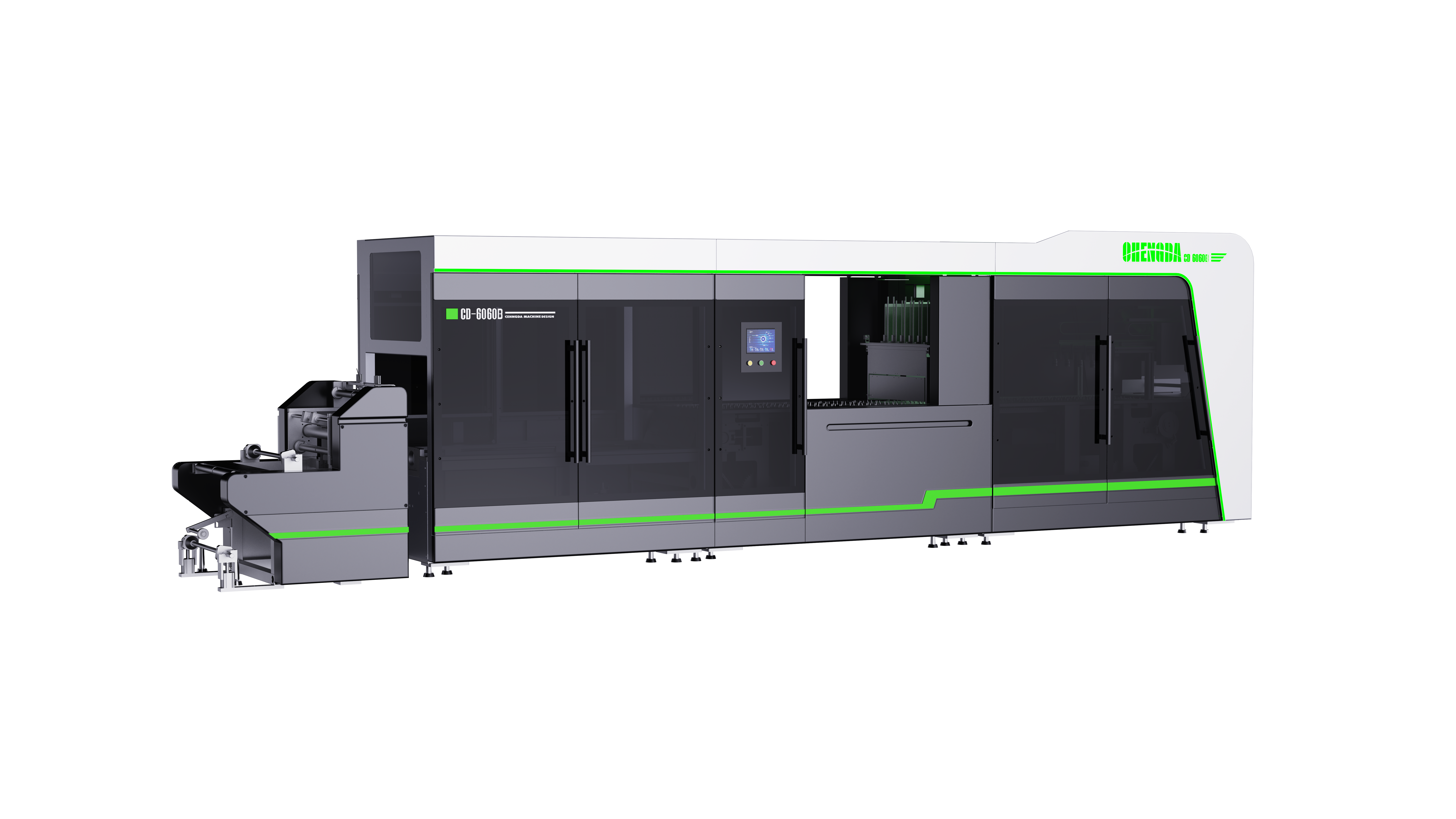
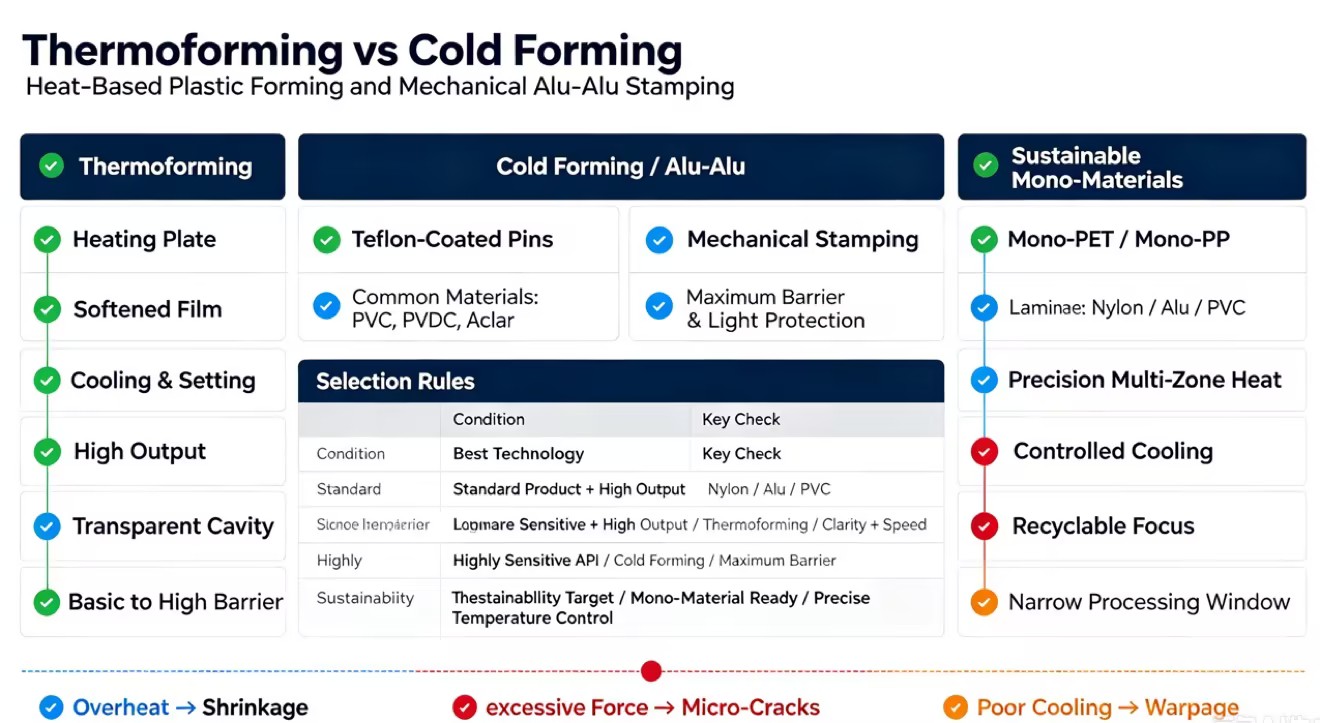
Thermoforming heats plastic films such as PVC, PVDC, or Aclar and forms them into blister cavities using air pressure or forming plugs. It generally supports faster production and lower material costs than Alu-Alu packaging, while transparent films also make product inspection easier. However, the level of moisture, oxygen, and light protection depends on the selected material, so higher-barrier packaging may be needed for sensitive pharmaceutical products.
Cold forming uses mechanical pressure to shape aluminum laminate into blister cavities without heating the forming web. Alu-Alu packaging provides high protection against moisture, oxygen, and light, making it suitable for sensitive pharmaceutical products. However, it generally uses more packaging material and operates at lower speeds than thermoforming. Because the aluminum cavities are opaque, vision inspection is usually performed before sealing to check product placement and quality.
Recyclable materials such as Mono-PET and Mono-PP are increasingly used in pharmaceutical blister packaging. These materials require accurate temperature control because uneven heating can cause warping or shrinking. Modern blister machines with multi-zone heating and stable cooling systems can better support these materials while maintaining consistent forming and sealing quality.
Packaging Material | Forming Technology | Barrier Protection Level | Visual Inspection | Processing Speed |
|---|---|---|---|---|
Standard PVC | Thermoforming (Heat) | Low (Basic dust/handling) | Transparent (Easy) | Very High |
PVDC Coated | Thermoforming (Heat) | Medium (Moisture/Oxygen) | Transparent (Easy) | High |
Aclar Laminate | Thermoforming (Heat) | High (Excellent Moisture) | Transparent (Easy) | High |
Alu-Alu Laminate | Cold Forming (Mechanical) | Maximum (Absolute Barrier) | Opaque (Requires Advanced Vision) | Moderate |
Mono-PET / Mono-PP | Thermoforming (Precision Heat) | Low to Medium | Transparent (Easy) | Moderate to High |
Blister machines should use compact, easy-to-clean designs that provide enough space for operation and maintenance. Balcony-style construction separates mechanical drive components from the product and packaging area, helping reduce contamination risks and simplify cleaning. Smooth surfaces and accessible machine areas also support cGMP requirements in pharmaceutical production.
Easy-to-change tooling helps reduce downtime between different blister formats. Tool-less designs with quick-release parts and lightweight components allow operators to replace forming dies, sealing plates, and punching tools more efficiently. Advanced machines may also use RFID-tagged tooling and HMI checks to verify the correct setup, helping reduce installation errors and improve changeover efficiency.
Platen sealing uses heated flat plates and longer sealing time, making it suitable for Alu-Alu and thicker packaging materials. Rotary sealing uses heated rollers with continuous web movement, supporting higher production speeds for materials such as PVC and PVDC. The right sealing method depends on the packaging material, production speed, and barrier requirements.
Blister machines can connect directly with cartoners and other downstream equipment for continuous production. Automated transfer systems move finished blisters to the cartoner, while buffer zones help manage short production stops. Vision systems detect defective blisters, and inline printing can add 2D codes for serialization and traceability. Integrated systems help improve production efficiency, quality control, and compliance.
Draft a rigorous User Requirement Specification (URS) document detailing every operational parameter, material tolerance, and facility constraint before contacting vendors.
Request detailed Overall Equipment Effectiveness (OEE) guarantees from shortlisted vendors based on your specific batch sizes and expected changeover frequencies.
Schedule physical machine demonstrations using your actual product samples and intended packaging films to validate feeding mechanisms and seal integrity.
Audit the vendor's documentation package to ensure they provide a complete Traceability Matrix for streamlined IQ/OQ/PQ execution.
A: The difference lies in the sealing mechanism. Rotary machines use continuous motion heated cylinders, allowing for high-speed production ideal for standard plastics. Flat-plate machines use intermittent platen pressing. This provides longer dwell times and higher pressure, making it essential for complex seals like Alu-Alu and sustainable mono-materials.
A: Equipment investment depends entirely on scale and integration requirements. Entry-level R&D units require minimal capital. High-speed, fully automated lines demand significant budgets. Robotic carton transfer, advanced vision inspection systems, and cleanroom compliance features drive the final investment scale. Tooling complexity and serialization modules also add to the base equipment requirements.
A: Regulatory bodies require strict validation. Installation Qualification (IQ) verifies proper setup. Operational Qualification (OQ) tests equipment functionality across specified parameters. Performance Qualification (PQ) proves consistent production quality. The equipment must also maintain 21 CFR Part 11 compliance for electronic records and data integrity.
A: Yes, most modern machines handle both formats. You achieve this by swapping specific format parts during changeovers. You will use dedicated tube feeders for capsules to ensure proper orientation. For tablets, you will install universal brush boxes or vibratory tracks depending on the tablet's coating and friability.
A: Legacy equipment often requires several hours and heavy tools for changeovers. Modern, balcony-design machines feature tool-less format parts using quick-release mechanisms. These advanced systems aim for changeovers taking between 30 to 45 minutes. This rapid turnaround is critical for supporting agile manufacturing and high-mix production schedules.
A: Alu-Alu refers to cold-formed blister packaging. Both the forming web and the lidding web consist of aluminum foil laminates. The machine stamps the cavities mechanically without using heat. This provides the highest possible barrier against moisture, oxygen, and light degradation, protecting highly sensitive active pharmaceutical ingredients.
A: Some can, but it often requires specific hardware. Running recyclable mono-materials like Mono-PET requires upgraded, highly precise heating and cooling stations. These films have narrow processing windows. Without exact multi-zone temperature control, the sustainable film will warp, shrink, or curl during the thermoforming process.